This will be my final blog post of 2015 - this year has been by far my most productive ever. I have learned more (mostly the hard way) than ever before but feel that there is still so much to learn that I am already looking forward to the next year! I hope for a very productive 2016 indeed, with many more projects to work on and to ultimately improve and becoming a better composer.
At this point I would like to point you in the direction of my youtube channel, which has a small compilation of my compositions from this year. For example:
Finally, I wish everyone a happy new year and many great things to come!
-PW

Wednesday, 30 December 2015

Wednesday, 11 November 2015
Compositional process: 'Dreaming'
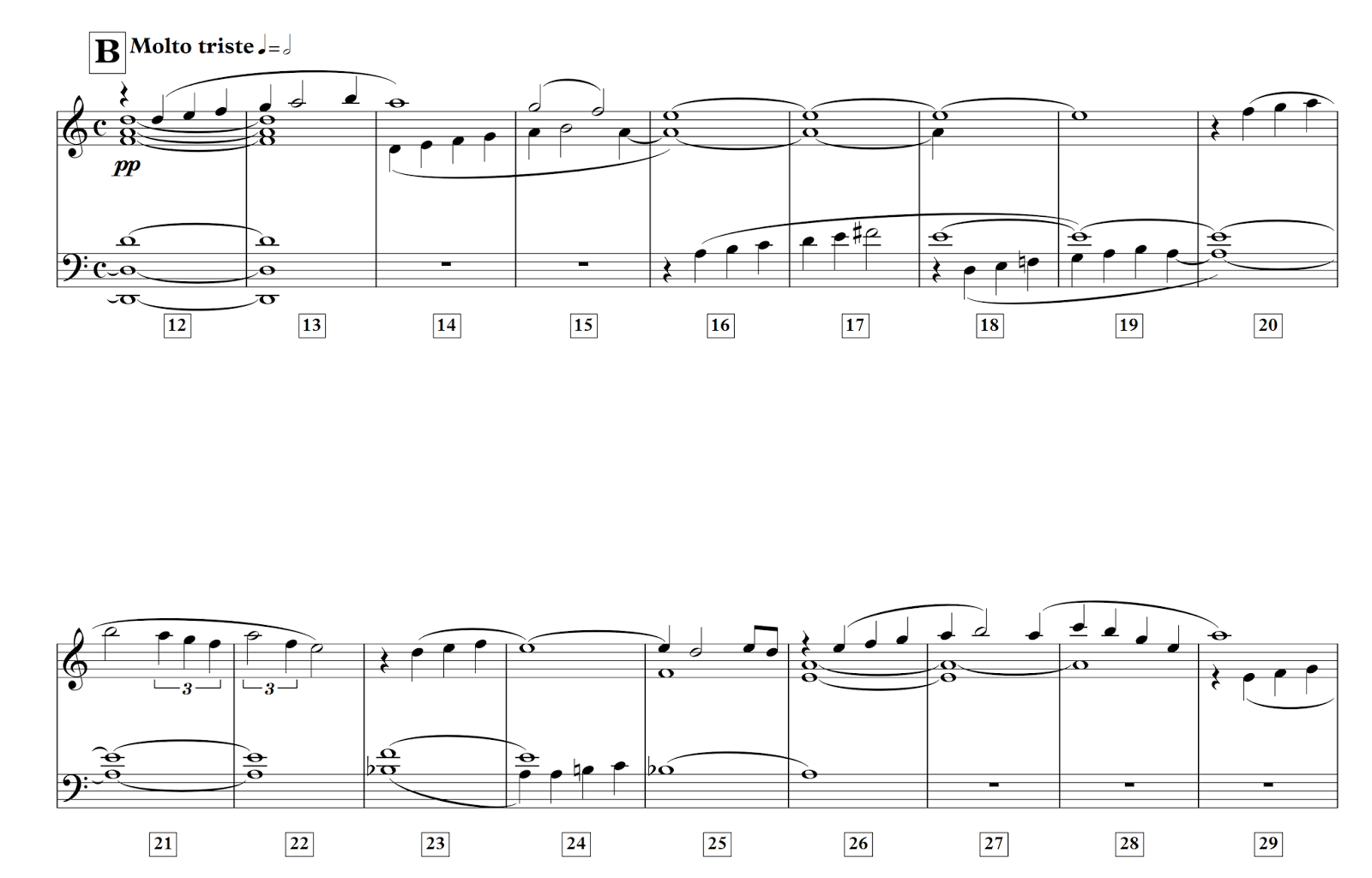
With 'Dreaming', I tried to evoke a dream-like quality for this track, not unlike something Thomas Newman would do. To achieve the effect, it was important to understand the 'ingredients' first: how to use the appropriate harmony, texture and tone colour.
1.) Harmony: The whole piece is build around harmony that 'hangs in the air'. In other words, I used fragmentary chords.
The first chord in bar 1 could be a C7, however the crucial 3rd is missing. Instead the 4th (F) and is part of the chord. To add to the confusion, the G falls to Eb, which would suggest Cm7. The next chord could be described as C6/9 but once again the describing interval (3rd) is missing, instead we have the 4th, 6th, 9th and 11th (4th). The next chord would probably be a Abadd2 over a C pedal. But once again, no 3rd (excluding the pedal C) but a 4th. The last chord of the phrase has the 3rd omitted as well.
The point is, that by leaving out the crucial interval in defining a chord (3rd) and using extensions instead, a somehow incomplete sounding chord is created that seems to be almost 'empty'. Also note that the left hand moves in clinically 5ths, providing the movement, whereas the right hand provides the emotion with extensions and suspensions.
2.) Texture: The overall texture is very light. I didn't want it to be too heavy and dense, otherwise I would have lost the 'floating' feel I was after. Piano, synths and strings is all that was needed.
3.) Tone colour: It was important to use a solo instrument for the main focus of the piece to create a feeling of loneliness but also to make the listening experience more direct. The piano was chosen because of the percussive nature of the instrument, being played two octaves higher than middle c, it creates almost a 'cold' and distant sound.
I used a synth pad underneath to bind things together. I tried using strings at first, however I felt that they would not communicate the 'etheral' feel as well as electronic sounds could.
The strings entering a bit later were chosen to get a bit of 'warmth' back into the piece.
Work flow:
My ideas usually come by just doodling/improvising at the piano. However, this piece was preconceived and I had to 'find' it on the instrument. This process involved a lot of trial and error but eventually I came up with a sketch:
Next up was creating an orchestral sketch, done in Sibelius (note the violins still providing the pad in the beginning):
The resulting audio mockup sounded like this:
After coming up with a basic orchestration, I imported the Sibelius midi into my sequencer and started creating the mockup proper. I like to keep things clear in Cubase, using colours and (especially important for me) tempo, time signature and marker tracks. As you can see, I didn't use a whole lot of tracks as I usually try to keep things as simple as possible.
Resulting mockup after mixing and tweaking:
Finally, mastering, where I only tried to 'pump up' the volume a bit to keep it competitive in terms of loudness.
Final piece:
I hope you found my way of working on this track interesting. Do feel free to provide feedback and comments!
-PW
1.) Harmony: The whole piece is build around harmony that 'hangs in the air'. In other words, I used fragmentary chords.
The first chord in bar 1 could be a C7, however the crucial 3rd is missing. Instead the 4th (F) and is part of the chord. To add to the confusion, the G falls to Eb, which would suggest Cm7. The next chord could be described as C6/9 but once again the describing interval (3rd) is missing, instead we have the 4th, 6th, 9th and 11th (4th). The next chord would probably be a Abadd2 over a C pedal. But once again, no 3rd (excluding the pedal C) but a 4th. The last chord of the phrase has the 3rd omitted as well.
The point is, that by leaving out the crucial interval in defining a chord (3rd) and using extensions instead, a somehow incomplete sounding chord is created that seems to be almost 'empty'. Also note that the left hand moves in clinically 5ths, providing the movement, whereas the right hand provides the emotion with extensions and suspensions.
2.) Texture: The overall texture is very light. I didn't want it to be too heavy and dense, otherwise I would have lost the 'floating' feel I was after. Piano, synths and strings is all that was needed.
3.) Tone colour: It was important to use a solo instrument for the main focus of the piece to create a feeling of loneliness but also to make the listening experience more direct. The piano was chosen because of the percussive nature of the instrument, being played two octaves higher than middle c, it creates almost a 'cold' and distant sound.
I used a synth pad underneath to bind things together. I tried using strings at first, however I felt that they would not communicate the 'etheral' feel as well as electronic sounds could.
The strings entering a bit later were chosen to get a bit of 'warmth' back into the piece.
Work flow:
My ideas usually come by just doodling/improvising at the piano. However, this piece was preconceived and I had to 'find' it on the instrument. This process involved a lot of trial and error but eventually I came up with a sketch:
 |
| early sketch |
Next up was creating an orchestral sketch, done in Sibelius (note the violins still providing the pad in the beginning):
 |
| Sibelius sketch |
The resulting audio mockup sounded like this:
After coming up with a basic orchestration, I imported the Sibelius midi into my sequencer and started creating the mockup proper. I like to keep things clear in Cubase, using colours and (especially important for me) tempo, time signature and marker tracks. As you can see, I didn't use a whole lot of tracks as I usually try to keep things as simple as possible.
 |
| Cubase project |
Resulting mockup after mixing and tweaking:
Finally, mastering, where I only tried to 'pump up' the volume a bit to keep it competitive in terms of loudness.
Final piece:
I hope you found my way of working on this track interesting. Do feel free to provide feedback and comments!
-PW
Sunday, 8 November 2015
Dario Marianelli 'Atonement' - short analysis
For this blog entry, I would like to share with you my brief analysis of Dario Marianelli's score for the 2007 film 'Atonement', for which he won the OSCAR for Best Original Soundtrack that year.
The score is quite remarkable in my opinion, not only because it has won the OSCAR or because it is wonderfully composed around, and an integral part of, the film but rather because of the efficiency of the musical material.
The score consists of 3 basic themes, which I will call BRIONY, ROBBIE AND CECILIA and WAR. There is only one music cue in the whole film that doesn't use any of the three themes (this being a short rendition of 'Claire de Lune' by Claude Debussy), as can be seen at the cue sheet I created:

Out of the three themes it is quite notable that BRIONY is used the most with making up more than 50% of the overall score. This is, however, not surprising as she is the lead character of the film and whose point of view we follow. ROBBIE AND CECILIA is essentially representing the love between these two characters, followed by WAR, which is depicting the hopelessness and horrors of the Second World War.
There are several characteristics of BRIONY (Fig. 1): the inventive use of a typewriter as a percussive instrument (appropriate as the character is a writer herself), also the cascading broken chords in the accompaniment (possibly to emphasise her youthful naivety) and finally, the melody itself. At this point I would like to redirect anyone reading this to Brian Morrell's fantastic analysis of said motive in his free online book: How Film and TV Music Communicate Vol.1 . The theme appears whenever Briony is seen on screen, pretty much like a classic leitmotif.
The melody of ROBBIE AND CECILIA (Fig.2) is often played by a solo instrument (clarinet, oboe, harmonica), possibly to signify their loneliness in being apart from each other. And indeed, the solo harmonica accompanies Robbie whenever we see him in the war, it is sometimes even played without any accompaniment at all. The only time we hear the theme fully fleshed out is when Robbie and Cecilia say goodbye to each in London, this is the only time both characters are on screen during the theme and therefore it is unsurprising, that it appears at its strongest orchestrally.
WAR (Fig. 3) is a chord progression that, in my opinion, manages to capture the horrors but also desperation of war. It is usually played during scenes of death and hopeless situations. It also appears at the end when the story of Robbie and Cecilia is revealed. Its B minor tonality and slow tempo contribute to the sad feeling as well as the orchestration for strings with solos for cello and violin.
These three themes are basically what the whole score consist of. I find it fascinating that a 2 hour film can be scored with as little as three contrasting musical ideas, given that they work and are also masterfully implemented. I hope that you found this entry informative, thank you for reading.
-PW
The score is quite remarkable in my opinion, not only because it has won the OSCAR or because it is wonderfully composed around, and an integral part of, the film but rather because of the efficiency of the musical material.
The score consists of 3 basic themes, which I will call BRIONY, ROBBIE AND CECILIA and WAR. There is only one music cue in the whole film that doesn't use any of the three themes (this being a short rendition of 'Claire de Lune' by Claude Debussy), as can be seen at the cue sheet I created:

Out of the three themes it is quite notable that BRIONY is used the most with making up more than 50% of the overall score. This is, however, not surprising as she is the lead character of the film and whose point of view we follow. ROBBIE AND CECILIA is essentially representing the love between these two characters, followed by WAR, which is depicting the hopelessness and horrors of the Second World War.
 |
| Fig. 1 BRIONY |
There are several characteristics of BRIONY (Fig. 1): the inventive use of a typewriter as a percussive instrument (appropriate as the character is a writer herself), also the cascading broken chords in the accompaniment (possibly to emphasise her youthful naivety) and finally, the melody itself. At this point I would like to redirect anyone reading this to Brian Morrell's fantastic analysis of said motive in his free online book: How Film and TV Music Communicate Vol.1 . The theme appears whenever Briony is seen on screen, pretty much like a classic leitmotif.
 |
| Fig.2, ROBBIE AND CECILIA |
The melody of ROBBIE AND CECILIA (Fig.2) is often played by a solo instrument (clarinet, oboe, harmonica), possibly to signify their loneliness in being apart from each other. And indeed, the solo harmonica accompanies Robbie whenever we see him in the war, it is sometimes even played without any accompaniment at all. The only time we hear the theme fully fleshed out is when Robbie and Cecilia say goodbye to each in London, this is the only time both characters are on screen during the theme and therefore it is unsurprising, that it appears at its strongest orchestrally.
 |
| Fig. 3 WAR |
WAR (Fig. 3) is a chord progression that, in my opinion, manages to capture the horrors but also desperation of war. It is usually played during scenes of death and hopeless situations. It also appears at the end when the story of Robbie and Cecilia is revealed. Its B minor tonality and slow tempo contribute to the sad feeling as well as the orchestration for strings with solos for cello and violin.
These three themes are basically what the whole score consist of. I find it fascinating that a 2 hour film can be scored with as little as three contrasting musical ideas, given that they work and are also masterfully implemented. I hope that you found this entry informative, thank you for reading.
-PW
Wednesday, 28 January 2015
The conventions and functions of the classical Hollywood score
I would like to share a short essay I have written about a year ago as part of my BA studies.
In this essay I tried to briefly outline the conventions and functions of film music in the 1930's Hollywood cinema.
I hope you enjoy!
-PW
In this essay I tried to briefly outline the conventions and functions of film music in the 1930's Hollywood cinema.
I hope you enjoy!
-PW
Wednesday, 24 December 2014
Bernard Herrmann – Walking Distance (Twilight Zone) - Part 3
With the concluding part of my analysis
of Bernard Herrmann's score for 'Walking Distance', I would like to
concentrate on his orchestration. Herrmann himself was a great
believer that every composer working on films should orchestrate his
own music as this quote of him illustrates:
'To orchestrate is like a thumbprint. I can't understand having someone else do it. It would be like someone putting color to your paintings.'
And indeed, he orchestrated every work
of his until his death.
That tells me that he valued orchestration as an important tool in order to communicate the music to the audience. I try to highlight some of his methods in this blog entry.
That tells me that he valued orchestration as an important tool in order to communicate the music to the audience. I try to highlight some of his methods in this blog entry.
Firstly, it should be noted that the ensemble used for this score was a very small one consisting of harp and a string section only. Even the string section is relatively small with 6 violins I, 4 violins II, 3 violas, 3 cellos and 2 basses. The reason for this could be an artistic one as the music almost exclusively portraits a single character and would therefore benefit of being confined to a few instruments or a small ensemble. Another reason, the one I believe to be the more likely, is that the budget for the music was limited and a small ensemble was all they could afford. Either way, the score offers a fascinating insight into Herrmann's approach for writing for such a small ensemble, especially bearing in mind that he wrote a similar score (albeit only for strings) a year later with 'Psycho'.
 |
| Intro |
The
second cue shows how to effectively use the harp to great effect. In
bars 4-5 [0:57], the strings hold an E7(b5)/Bb chord as a pad for the
harp to play a downward arpeggio of an E7. The tonal qualities of the
harp create a sense of foreboding and danger. Note also, how the
chord doesn't change (although the voicing does) but the notes for
the individual string sections do – a subtle detail to make the parts
more interesting.
 |
| The Drugstore |
The
third cue ('Memories'), illustrates one of the cornerstones of Herrmann's compositional as well as orchestral style: the development of motifs.
In the opening two bars [1:37], he scores the 'memory motif' for
violins (violins II and first desk of violins I an octave apart
with the second desk of violins I a third below) with cellos and
violas for the chord pad. For the return of the motif in bars 15 –
16 [2:39], he scores it in a much lighter texture with violins
only for the theme and chord pad.
In bar 19, he introduces cellos (note that they are playing the chord tutti now) and double basses to clearly define the chord as A minor, to then add a harp arpeggio (with the same effect as in the previous cue) in Ab major in second inversion. I have highlighted the violas, that support the harp only ever so slightly with the same chord played flautando, the effect gained is hauntingly chilling.
In bar 19, he introduces cellos (note that they are playing the chord tutti now) and double basses to clearly define the chord as A minor, to then add a harp arpeggio (with the same effect as in the previous cue) in Ab major in second inversion. I have highlighted the violas, that support the harp only ever so slightly with the same chord played flautando, the effect gained is hauntingly chilling.
 |
| Memories |
In 'The Park' [4:27], Herrmann offers
us an interesting approach of scoring a simple waltz theme. The harp
plays the basic accompaniment, while the second desks of violins I
and II play tonic and dominant harmonics respectively. The first
desks play the same harmonics but twice as fast as the second
desks. The remaining two first violins, play the theme a third apart
to complete the whole texture. Once again, the scoring here is very
light and thin but at the same time creates a sort of carefree
atmosphere.
 |
| The Park |
 |
| The House |
The opening bars of 'The
Merry-go-round' [10:24] shows one of the very few instances where the
violins are not to be played with mutes. The motif is represented by
violins I at first before answered an octave lower by violins II. The
dynamic of ff and the tempo marking indicate that a harsh
and intense sound is desired. Once again although repetitive, Herrmann
makes each part more interesting by throwing phrases around and thus
keeping the sections but also the listener entertained.
 |
| The Merry-go-round |
For the final example I want to go back
to what I was pointing out in the third cue: the development of
motifs.
Section A [11:50] shows the initial chord motif, divided onto all string sections apart from double basses, playing with the same rhythm. At section B [12:34], the meter changes and basses are now introduced, to play a pedal D along with the cellos. The chord theme is now divided onto violas and violins. The melodic rhythm has now changed and is much more elaborate. At section C [0:01 second video] (the beginning of the 'Elegy' cue), the pedal D has gone, the meter is back to where it was but the whole theme is condensed to strings alone. Section D [0:48], represents even more condensing. Back is the pedal D and the change in meter but this time everything is scored for cellos and violas only.
I hope it can be seen how Herrmann was able to alter the tone and character of the same music by the use of (sometime subtle) variations throughout his orchestration. This, I believe, is the key to the success and popularity of his music as it rarely becomes tiring although being incredibly repetitive.

Section A [11:50] shows the initial chord motif, divided onto all string sections apart from double basses, playing with the same rhythm. At section B [12:34], the meter changes and basses are now introduced, to play a pedal D along with the cellos. The chord theme is now divided onto violas and violins. The melodic rhythm has now changed and is much more elaborate. At section C [0:01 second video] (the beginning of the 'Elegy' cue), the pedal D has gone, the meter is back to where it was but the whole theme is condensed to strings alone. Section D [0:48], represents even more condensing. Back is the pedal D and the change in meter but this time everything is scored for cellos and violas only.
I hope it can be seen how Herrmann was able to alter the tone and character of the same music by the use of (sometime subtle) variations throughout his orchestration. This, I believe, is the key to the success and popularity of his music as it rarely becomes tiring although being incredibly repetitive.
This concludes my blog about Bernard Herrmann's orchestration for the score to 'Walking Distance' and indeed my 3 part blog series about the score itself. I hope you found it interesting and informative but also motivating to explore more of Herrmann's music, as there is much to be learnt from it.
-PW
These transcriptions are entirely my own and only intended for educational purposes.
Thursday, 18 December 2014
Bernard Herrmann – Walking Distance (Twilight Zone) - Part 2
This is the second part of my 3 part
blog series about Bernard Herrmann's score for 'Walking Distance'
(1959), an episode from the CBS Television series The Twilight Zone.
It is highly recommended that you go through the first part (Bernard Herrmann - Walking Distance (Twilight Zone) - Part 1) before
commencing on to this entry, as you will then be able to understand
the whole score in its entirety.
7. The Parents:


The cue begins after Martin stumbles over his old baseball glove upon returning to his childhood home. No surprise that Herrmann used the 'memory motif' for this scene in order to play the character. The interplay between visuals, audio and music is impressive as the music is played under the narration explaining the current state of Martin Sloan, picking up his glove and thinking about past times that are long gone.
A different section (B) is introduced at bar 9 to underscore the dialogue between Martin and his father. This section is keeping the nostalgic mood mostly with the use of 7th chords in A minor.
Bars 24-27 are along the same lines (leaning towards a G major tonality), acting as a sort of bridge between this and the following section starting at bar 28.
This section (C) begins with a descending 4 note motif, which is a development of the 'yearning motif' from the 'Intro' cue. This time however, it sounds more aggressive without the rise up a semitone. The fortissimo dynamic and dissonant harmonies convey a rather anxious mood, which fits with the action on screen as Martin is now almost begging his mother to understand that he is her son. This whole pattern intensifies in dynamic and tempo with the use of tremolo chords (a favourite of Herrmann for intensification as in 'Scene D'amour' from 'Vertigo') until the end in bar 41.
8. The Merry-go-round:

An almost seamless continuation of the previous cue, this cue starts with the more anxious 'yearning motif', this time even more intense and isolated as it is played at the higher end of the violin range. The underlying implied harmony is going down in semitones, as the motif is working its way down too. The scene shows a close up of Martin's face after his mother wouldn't listen and slapped him. This cue makes a very good example of scoring the characters feelings: the music depicts Martin's confusion, rejection, loneliness, isolation and yearning all at once with simple devices.
The cue follows the basic structure of 'The Parents' and indeed it is little more than a copy. However, it should be noted how well Herrmann synchronises Martin running off to the merry-go-round, with the use of pizzicato bass (similar to the synchronisation of the wind shield wipers in 'Psycho').
Overall, this is possibly my favourite cue of the whole score and a good lesson in itself for effective film scoring.
9. Martin's summer:
The cue begins after Martin stumbles over his old baseball glove upon returning to his childhood home. No surprise that Herrmann used the 'memory motif' for this scene in order to play the character. The interplay between visuals, audio and music is impressive as the music is played under the narration explaining the current state of Martin Sloan, picking up his glove and thinking about past times that are long gone.
A different section (B) is introduced at bar 9 to underscore the dialogue between Martin and his father. This section is keeping the nostalgic mood mostly with the use of 7th chords in A minor.
Bars 24-27 are along the same lines (leaning towards a G major tonality), acting as a sort of bridge between this and the following section starting at bar 28.
This section (C) begins with a descending 4 note motif, which is a development of the 'yearning motif' from the 'Intro' cue. This time however, it sounds more aggressive without the rise up a semitone. The fortissimo dynamic and dissonant harmonies convey a rather anxious mood, which fits with the action on screen as Martin is now almost begging his mother to understand that he is her son. This whole pattern intensifies in dynamic and tempo with the use of tremolo chords (a favourite of Herrmann for intensification as in 'Scene D'amour' from 'Vertigo') until the end in bar 41.
8. The Merry-go-round:
An almost seamless continuation of the previous cue, this cue starts with the more anxious 'yearning motif', this time even more intense and isolated as it is played at the higher end of the violin range. The underlying implied harmony is going down in semitones, as the motif is working its way down too. The scene shows a close up of Martin's face after his mother wouldn't listen and slapped him. This cue makes a very good example of scoring the characters feelings: the music depicts Martin's confusion, rejection, loneliness, isolation and yearning all at once with simple devices.
The cue follows the basic structure of 'The Parents' and indeed it is little more than a copy. However, it should be noted how well Herrmann synchronises Martin running off to the merry-go-round, with the use of pizzicato bass (similar to the synchronisation of the wind shield wipers in 'Psycho').
Overall, this is possibly my favourite cue of the whole score and a good lesson in itself for effective film scoring.
9. Martin's summer:


The next cue starts on a sforzando E in the basses and cellos after Martin tried to speak to the young Martin at the merry-go-round, which results in him (young Martin) falling off and hurting his leg. The cue continues with a series of 7th chords over pedal tones, to heighten the drama on screen.
A new section (B) starts at bar 5, which on the first glance might look like an ordinary melodic fragment, however I believe this to be a continuation of the development of the 'yearning motif' (note the harp arpeggios), this time with obvious rhythmic alterations. This new motif gets repeated in true Herrmann-style until bar 15. The scene it underscores shows Martin, disillusioned with the world, slowly walking off the merry-go-round to speak to the young Martin (probably the most memorable moment from the whole episode: he is spotlighted while all the other children get off the merry-go-round in the background, leaving him completely exposed).
As he explains his motives for coming into this world to his younger self, a choral like chord progression is heard (C). In my view, this is yet another development in the score, this time from the chord progression heard in the 'The Parents' cue. The harmonic progression is rather unspectacular with a circle of fifths movement starting on a D minor triad. In bar 21 Herrmann used a Neapolitan 6th chord as part of the concluding cadence.
From bar 23 onwards until the end in bar 28, this section gets repeated with a development in part-writing and a change in metre.
10. Elegy:



The longest cue incorporates many musical devices and ideas up until this point in the score.
The first 11 bars are basically a repeat of the final section of the previous cue as Martin is confronted by his father.
The section that follows it (B) is build on the dorian mode (starting in D), with melodies divided into four voices and ending with chord movements (bars 35-40). The music here simply underscores the dialogue between Martin and his father.
The second to last section (C) starting at bar 42, is the last time we hear the 'memory motif' from the 'Memories' cue. Sure enough, Martin starts to recollect moments from his childhood at exactly this moment.
The final section (D) is a reprise of the bi-tonality section from 'Memories', however this time it is slightly modified with another chord in between. Unsurprisingly, this chord is a semitone up from the chord that precedes it – the semitone movement of melodies and chords being a common feature of the score.
Tremolo strings to intensify (common for Herrmann) and a pizzicato bass line down to A bring the cue to an end at bar 57.
11.Finale:
The longest cue incorporates many musical devices and ideas up until this point in the score.
The first 11 bars are basically a repeat of the final section of the previous cue as Martin is confronted by his father.
The section that follows it (B) is build on the dorian mode (starting in D), with melodies divided into four voices and ending with chord movements (bars 35-40). The music here simply underscores the dialogue between Martin and his father.
The second to last section (C) starting at bar 42, is the last time we hear the 'memory motif' from the 'Memories' cue. Sure enough, Martin starts to recollect moments from his childhood at exactly this moment.
The final section (D) is a reprise of the bi-tonality section from 'Memories', however this time it is slightly modified with another chord in between. Unsurprisingly, this chord is a semitone up from the chord that precedes it – the semitone movement of melodies and chords being a common feature of the score.
Tremolo strings to intensify (common for Herrmann) and a pizzicato bass line down to A bring the cue to an end at bar 57.
11.Finale:
%2B-%2BTZ%2B-%2BWalking%2BDistance.png)
The final cue is an exact copy of the 'Intro' cue with the added bi-tonality section at the end. This time however, this section comes to rest on an E major triad as Martin drives off and leaves his home-town behind. I believe that the sense of closure is achieved because Herrmann introduces the E major triad (E7) as the final chord of the first cue in the score.
This
marks the end of my cue by cue analysis of Bernard Herrmann's score
to 'Walking Distance'. I hope it was informative and showed how an
effective score can be achieved with only a small amount of musical
devices, provided that it is well executed.
Part 3 will focus on Herrmann's orchestration for this score, as it was a vital component to fully express his musical ideas and also because it will show how he was able to use a small ensemble (strings and harp) to the best effect.
-PW
These transcriptions are entirely my own and only intended for educational purposes.
Part 3 will focus on Herrmann's orchestration for this score, as it was a vital component to fully express his musical ideas and also because it will show how he was able to use a small ensemble (strings and harp) to the best effect.
-PW
These transcriptions are entirely my own and only intended for educational purposes.
Friday, 12 December 2014
Bernard Herrmann – Walking Distance (Twilight Zone) - Part 1
With this 3 part blog series I want to
give an insight into how Bernard Herrmann constructed his scores and
especially how he used simple methods to greatest effect. As an
example I will use his score for the 'Walking Distance' (1959)
episode from the CBS TV series Twilight Zone. I have chosen this
particular score as its relative short length makes it easier to
understand as a whole but also because it reflects many of Herrmann's
trademarks.
Part 1 and 2 will be a cue by cue analysis of the
whole score while part 3 will be focusing on his orchestration only.
I can only encourage everyone
interested in film scoring to have a look at William Wrobels website: http://www.filmscorerundowns.net/,
where you can find cue by cue analyses of almost every Herrmann score
ever written. I would also recommend 'A Heart at Fire's Centre: The Life and Music of Bernard Herrmann'
written by Steven C. Smith, to get a better view of Herrmann as an
artist.
Finally, I hope I can give enough information to get a grasp of this score and indeed of Herrmanns methods of composing for film and that I can encourage people to listen more to his scores as they give a great insight into the most direct approach to film scoring.
List of cues:
1. Intro
2. The Drugstore
3. Memories
4. The Park
5. The House
6. Curtain
7. The Parents
8. The merry-go-round
9. Martin's summer
10. Elegy
11. Finale (Walking)

The
first cue of the score is essentially what Bernard Herrmann's music
was best known for: short cell-like motifs, repetition and the use
of half-diminished seventh harmonies.
The cue is being played while the main character, Martin Sloan, is introduced by a narrator.
The first motif we hear is a 4-note figure, which gives a clue of the state of mind of the main-character straight away. The figure is rising a semitone before falling back on its starting note only to fall another note down after that. This suggests to me a sense of yearning but also despair, which characterises Martin Sloan and his quest for wanting to relive his past. Therefore, I would call it the 'yearning motif'.
The cue is being played while the main character, Martin Sloan, is introduced by a narrator.
The first motif we hear is a 4-note figure, which gives a clue of the state of mind of the main-character straight away. The figure is rising a semitone before falling back on its starting note only to fall another note down after that. This suggests to me a sense of yearning but also despair, which characterises Martin Sloan and his quest for wanting to relive his past. Therefore, I would call it the 'yearning motif'.
 |
| yearning motif |
The very first chord we
encounter is a half-diminished seventh (built on C#) - possibly
Herrmann's most frequently used1.
The cue continues
with a repetition of the 'yearning motif' for 4 bars until a slight
variation in the melody signals the ending. The final chord of the
cue is E7, which I find significant as it will be the final chord of
the whole score.
Herrmann
immediately establishes an uneasy mood by the use of falling
semi-tone patterns, mostly seventh chords and slow tempo but he also
creates a sense of yearning and nostalgia with his orchestration for
strings and harp only.

The
second cue recalls the intro (bar 5) in the first 3 bars, which is
preceded by a change in mood starting at bar 4. The unstable E7b5
chord is more or less the tonal centre for the next 4 bars on top of
which the harp plays a descending arpeggio of said chord
(highlighted). Very simple methods but note how they create a
completely different feel, which is directly associated with the
events on the screen as bar 4 begins exactly as Sloan enters the
Drugstore. It gives the impression that something is not quite right. Bars
8-9 repeat the same idea but this time played over Ab+ and G+
harmonies respectively. A repetition of said chords in bar 10 brings
the cue to a close on a D diminished triad in first inversion in bar
11.

4. The Park:
3. Memories:
This cue starts
with another motif, which I like to call the 'memory motif' because
of its constant appearance whenever Martin recollects something from
his past (in this instance how he loved his ice cream as a
child):
 |
| memory motif |
As with the intro cue, this 2 bar
motif gets repeated in typical Herrmann fashion for the next few
bars until bar 9. Note that the Fb Major chord of bar 7 functions as
an E Major chord in A Minor, which results in a perfect
cadence.
Bars 9-14 introduce a second subject in a major tonality (contrasting to the previous A Minor) before the cue returns to the initial motif in bar 15.
Bars 18-19 (highlighted) and subsequently are interesting for two reasons. Mainly because of its bi-tonality of A Minor and Ab Major but also because it gives us a hint at the final cue. As with the previous cue, a substantial shift in mood is created by the aforementioned bi-tonality, which further manifests the unnerving feeling that something is not quite right. Note also that Herrmann introduces this figure after Martin Sloan has left the Drugstore, which gives this and the previous cue a subtle sense of synchronisation with the picture.
The cue returns once again to the 'memory motif' in bar 27, as we see Martin walking through a park and relishing moments from his past. This further emphasises the connection of this motif with Martin's memories.
Bars 9-14 introduce a second subject in a major tonality (contrasting to the previous A Minor) before the cue returns to the initial motif in bar 15.
Bars 18-19 (highlighted) and subsequently are interesting for two reasons. Mainly because of its bi-tonality of A Minor and Ab Major but also because it gives us a hint at the final cue. As with the previous cue, a substantial shift in mood is created by the aforementioned bi-tonality, which further manifests the unnerving feeling that something is not quite right. Note also that Herrmann introduces this figure after Martin Sloan has left the Drugstore, which gives this and the previous cue a subtle sense of synchronisation with the picture.
The cue returns once again to the 'memory motif' in bar 27, as we see Martin walking through a park and relishing moments from his past. This further emphasises the connection of this motif with Martin's memories.


The
whole cue is basically just a simple waltz with a coda at the end.
The waltz itself is almost sentimental for Herrmann's standards and
uses simple dominant tonic relations as its harmonic foundation.


The cue becomes interesting at bar 19 when Martin sees his
younger self carving his name on a wooden post in the park. Herrmann
plays this moment with downward moving thirds, always intensifying,
until the cue ends on a G/B major third interval in bar 26.
By now it has become clear that Martin Sloan has somehow travelled back in time, to the place he grew up as a child.
By now it has become clear that Martin Sloan has somehow travelled back in time, to the place he grew up as a child.
5. The House:
This
cue starts with a violent octave figure in the low strings as Martin
is confronted with his past for the first time, while talking to his
younger self. It is the first time the score deviates from its
mostly nostalgic and bitter-sweet mood into something more rough and
edgy.
This 5 bar figure is followed by the last reoccurring motif in the score, a diatonic chord progression in triple metre. The motif starts as the scene changes to Sloan walking up the front yard to his childhood home. For me, this motif succeeds the most in capturing a sense of nostalgia and longing for the past.
Bars 14-19 might be seen as an interlude passage with its predominantly romantic sounding major and minor 9ths chords, while Sloan approaches his parents on the doorstep to his home.
The mood shifts again as he is turned away by his parents and anger starts to surface. Herrmann's music reflects this with an increase in volume, tempo and with an accented bass line over an tremolo F half diminished 7th chord (recalling the opening of the cue).
The 'longing motif' appears again (bar 24) as he turns away but this time more aggressively played by fortissimo strings instead of arpeggio harp.
A trademark of Herrmann's style, which has hopefully become apparent by now, is that if he is using motifs, he is restricting them very often to 1 or 2 bar phrases. This approach needs a lot of variations of all sorts to not become tiring and indeed it is remarkable how Herrmann was able to incorporate such a vast amount of repetition into his music without making it sound tiresome.
This 5 bar figure is followed by the last reoccurring motif in the score, a diatonic chord progression in triple metre. The motif starts as the scene changes to Sloan walking up the front yard to his childhood home. For me, this motif succeeds the most in capturing a sense of nostalgia and longing for the past.
Bars 14-19 might be seen as an interlude passage with its predominantly romantic sounding major and minor 9ths chords, while Sloan approaches his parents on the doorstep to his home.
The mood shifts again as he is turned away by his parents and anger starts to surface. Herrmann's music reflects this with an increase in volume, tempo and with an accented bass line over an tremolo F half diminished 7th chord (recalling the opening of the cue).
The 'longing motif' appears again (bar 24) as he turns away but this time more aggressively played by fortissimo strings instead of arpeggio harp.
A trademark of Herrmann's style, which has hopefully become apparent by now, is that if he is using motifs, he is restricting them very often to 1 or 2 bar phrases. This approach needs a lot of variations of all sorts to not become tiring and indeed it is remarkable how Herrmann was able to incorporate such a vast amount of repetition into his music without making it sound tiresome.
6. Curtain:
The
cue is the shortest in the score and was possibly designed to make a
'statement' to conclude the first part of the episode. Sloan has now
fully realised that he has somehow been transported into the past
after the neighbour showed him a brand new car from about 20 years
ago. The music is basically a falling pattern of thirds,
intensifying in volume before concluding in a rather unsurprising E
half-diminished seventh chord.
This
concludes the first part of my cue by cue analysis. The second part
(cues 7-11) will be online in a few days.
-PW
These transcriptions are entirely my own and only intended for educational purposes.
These transcriptions are entirely my own and only intended for educational purposes.
1 Half-diminished Seventh:
The Bernard Herrmann chord by William Wrobel: http://www.filmscorerundowns.net/herrmann/herrmannchord.pdf
Subscribe to:
Comments (Atom)