Friday, 12 December 2014

Bernard Herrmann – Walking Distance (Twilight Zone) - Part 1

With this 3 part blog series I want to give an insight into how Bernard Herrmann constructed his scores and especially how he used simple methods to greatest effect. As an example I will use his score for the 'Walking Distance' (1959) episode from the CBS TV series Twilight Zone. I have chosen this particular score as its relative short length makes it easier to understand as a whole but also because it reflects many of Herrmann's trademarks.
Part 1 and 2 will be a cue by cue analysis of the whole score while part 3 will be focusing on his orchestration only.
I can only encourage everyone interested in film scoring to have a look at William Wrobels website: http://www.filmscorerundowns.net/, where you can find cue by cue analyses of almost every Herrmann score ever written. I would also recommend 'A Heart at Fire's Centre: The Life and Music of Bernard Herrmann' written by Steven C. Smith, to get a better view of Herrmann as an artist.

Finally, I hope I can give enough information to get a grasp of this score and indeed of Herrmanns methods of composing for film and that I can encourage people to listen more to his scores as they 
give a great insight into the most direct approach to film scoring.


List of cues:


1. Intro
2. The Drugstore
3. Memories
4. The Park
5. The House
6. Curtain
7. The Parents
8. The merry-go-round
9. Martin's summer
10. Elegy
11. Finale (Walking)


1. Intro:


The first cue of the score is essentially what Bernard Herrmann's music was best known for: short cell-like motifs, repetition and the use of half-diminished seventh harmonies.
The cue is being played while the main character, Martin Sloan, is introduced by a narrator.
The first motif we hear is a 4-note figure, which gives a clue of the state of mind of the main-character straight away. The figure is rising a semitone before falling back on its starting note only to fall another note down after that. This suggests to me a sense of yearning but also despair, which characterises Martin Sloan and his quest for wanting to relive his past. Therefore, I would call it the 'yearning motif'.

yearning motif

The very first chord we encounter is a half-diminished seventh (built on C#) - possibly Herrmann's most frequently used1. The cue continues with a repetition of the 'yearning motif' for 4 bars until a slight variation in the melody signals the ending. The final chord of the cue is E7, which I find significant as it will be the final chord of the whole score.
Herrmann immediately establishes an uneasy mood by the use of falling semi-tone patterns, mostly seventh chords and slow tempo but he also creates a sense of yearning and nostalgia with his orchestration for strings and harp only.


2. The Drugstore:

The second cue recalls the intro (bar 5) in the first 3 bars, which is preceded by a change in mood starting at bar 4. The unstable E7b5 chord is more or less the tonal centre for the next 4 bars on top of which the harp plays a descending arpeggio of said chord (highlighted). Very simple methods but note how they create a completely different feel, which is directly associated with the events on the screen as bar 4 begins exactly as Sloan enters the Drugstore. It gives the impression that something is not quite right. Bars 8-9 repeat the same idea but this time played over Ab+ and G+ harmonies respectively. A repetition of said chords in bar 10 brings the cue to a close on a D diminished triad in first inversion in bar 11.


3. Memories:

This cue starts with another motif, which I like to call the 'memory motif' because of its constant appearance whenever Martin recollects something from his past (in this instance how he loved his ice cream as a child):

memory motif

As with the intro cue, this 2 bar motif gets repeated in typical Herrmann fashion for the next few bars until bar 9. Note that the Fb Major chord of bar 7 functions as an E Major chord in A Minor, which results in a perfect cadence.
Bars 9-14 introduce a second subject in a major tonality (contrasting to the previous A Minor) before the cue returns to the initial motif in bar 15.
Bars 18-19 (highlighted) and subsequently are interesting for two reasons. Mainly because of its bi-tonality of A Minor and Ab Major but also because it gives us a hint at the final cue. As with the previous cue, a substantial shift in mood is created by the aforementioned bi-tonality, which further manifests the unnerving feeling that something is not quite right. Note also that Herrmann introduces this figure after Martin Sloan has left the Drugstore, which gives this and the previous cue a subtle sense of synchronisation with the picture.
The cue returns once again to the 'memory motif' in bar 27, as we see Martin walking through a park and relishing moments from his past. This further emphasises the connection of this motif with Martin's memories.


4. The Park:

The whole cue is basically just a simple waltz with a coda at the end. The waltz itself is almost sentimental for Herrmann's standards and uses simple dominant tonic relations as its harmonic foundation. 
The cue becomes interesting at bar 19 when Martin sees his younger self carving his name on a wooden post in the park. Herrmann plays this moment with downward moving thirds, always intensifying, until the cue ends on a G/B major third interval in bar 26.
By now it has become clear that Martin Sloan has somehow travelled back in time, to the place he grew up as a child.


5. The House:

This cue starts with a violent octave figure in the low strings as Martin is confronted with his past for the first time, while talking to his younger self. It is the first time the score deviates from its mostly nostalgic and bitter-sweet mood into something more rough and edgy.
This 5 bar figure is followed by the last reoccurring motif in the score, a diatonic chord progression in triple metre. The motif starts as the scene changes to Sloan walking up the front yard to his childhood home. For me, this motif succeeds the most in capturing a sense of nostalgia and longing for the past.
Bars 14-19 might be seen as an interlude passage with its predominantly romantic sounding major and minor 9ths chords, while Sloan approaches his parents on the doorstep to his home.
The mood shifts again as he is turned away by his parents and anger starts to surface. Herrmann's music reflects this with an increase in volume, tempo and with an accented bass line over an tremolo F half diminished 7th chord (recalling the opening of the cue).
The 'longing motif' appears again (bar 24) as he turns away but this time more aggressively played by fortissimo strings instead of arpeggio harp.
A trademark of Herrmann's style, which has hopefully become apparent by now, is that if he is using motifs, he is restricting them very often to 1 or 2 bar phrases. This approach needs a lot of variations of all sorts to not become tiring and indeed it is remarkable how Herrmann was able to incorporate such a vast amount of repetition into his music without making it sound tiresome.


6. Curtain:

The cue is the shortest in the score and was possibly designed to make a 'statement' to conclude the first part of the episode. Sloan has now fully realised that he has somehow been transported into the past after the neighbour showed him a brand new car from about 20 years ago. The music is basically a falling pattern of thirds, intensifying in volume before concluding in a rather unsurprising E half-diminished seventh chord.


This concludes the first part of my cue by cue analysis. The second part (cues 7-11) will be online in a few days.

-PW


These transcriptions are entirely my own and only intended for educational purposes.

1 Half-diminished Seventh: The Bernard Herrmann chord by William Wrobel: http://www.filmscorerundowns.net/herrmann/herrmannchord.pdf

Monday, 1 December 2014

Violinenstück Nr. 1


I had planned to write a piece for solo violin and piano for a while, but it only materialised after listening to John Williams' score for 'Schindlers' List' [1993].

In many of the pieces composed for that film, one can often find very singable melodies carried by solo violin, almost akin to the voice in a song. This reminded me of a chord progression I was working on for quite some time but I never knew what to do with it. But since it seemed most appropriate to function as the foundation of a song, I thought it would work well with a melody played by solo violin instead of being sung by a human voice.
But since I have never embarked on writing such a piece, I needed to do some research, which mainly focused on listening and score-reading of well know pieces.
My listening list conained the following pieces:

L. v. Beethoven - Violin Sonata No.9, Op. 43 'Kreutzer'
S. Rachmaninoff - Cello Sonata, Op. 19
S. Rachmaninoff - Vocalise, Op. 34 No. 14 
F. Chopin - Cello Sonata, Op. 65
A. Dvorak - Violin Sonatina, Op. 100 + 5 Romantic Pieces, Op. 75
E. Elgar - Violin Sonata, Op. 82
J. Brahms - Violin Sonatas 1-3 (Op. 78, Op. 100, Op. 108) 
C. Franck - Violin Sonata A major
M. Ravel - Tzigane
C. Debussy - Violin Sonata, L. 140
C. Ives - Violin Sonatas 1-4
A. Schönberg - Phantasy for Violin and Piano, Op. 47

My main concern in terms of arranging both instruments was for the piano part, as the appropriate melody for violin came naturally to me. Learning a lot by doing my research, I eventually figured out that contrast is most likely the best way to arrive at a part that is interesting to perform, coherent and contributing in the overall sonority of the piece. Contrast was mainly achieved by rhythmic variety as can be best seen in the opening phrases starting at A, which change their rhythm every four bars. But also at B, where the piano part becomes the main focus and plays solo.

The underlying structure is best divided into four parts: opening, main motif (A), contrasting theme (B) and resolution (C). The harmonic basis is very simple. The opening is demonstrating a simple I-IV progression in g minor, although it feels like a V-I in C minor. 
The main motif (A) is dominated by a IV-I progression in G minor, with an emphasis on the major 9th and minor 7th respectively. The contrasting theme (B) is constructed by a I-V progression in g minor, using 9th and 7th again until it reaches its harmonic climax on an E-flat major chord in bar 43. After a short modulation, the resolution (C) is being approached in the key of D major with IV-I progressions to create a calming effect but also to complement the initial progression of the opening.

Overall, I have learned a lot by writing a piece for two solo instruments which will help me to improve as a composer writing for a variety of ensembles.

-PW

Saturday, 30 August 2014

Creative strings in Liszt's 'Mazeppa'

In his Symphonic Poem no. 6 'Mazeppa', Franz Liszt (1811-1886) makes use of many different string techniques in the passage on page 116 of the Dover full score. Listen to the passage (at 3:41):


Looking at the score, one can see that he predominantly used percussive effects such as pizzicato and col legno to create a kind of eerie atmosphere.
The basses play the root note pizzicato, doubled by the cellos an octave higher. Note that the 2nd desk of cellos play the note arco, while the first desk arpeggiating the chord pizzicato.


The 2nd desks of 2nd violins, violas and cellos have the chord divided between them in a quaver triplet group, to create rhythmic interest. These groups are played col legno (with the wood of the bow) to further emphasize the percussive nature of the passage.


The 1st desk of violas acts as a kind of counterpoint to the arpeggiated pizzicato chord played by the 1st desk of cellos. However, the viola downward arpeggio is played marcatissimo (a little less than marked) instead of pizzicato. He also further emphasizes this phrase by the rinf (reinforced) dynamic.


The 1st desk of 1st and 2nd violins respectively play the chord as a fingered tremolo, to create a soft pedal as contrast to the predominantly rhythmic phrases and motifs in the lower strings. The violins are also divided and marked p, which lets them sit nicely in the background without being obtrusive.


Finally, Liszt introduces 2 solo violins to play a pizzicato downward arpeggio similar to the one in the cellos but here in crotchet triplets. This is arguably the most prominent line in the whole passage.


Overall, I think Liszt used his strings very delicatly in this particular passage, which is further emphasized by their function as a rythmic and contrasting background to the expressive woodwind melody on top.

-PW

Friday, 25 July 2014

Howard Shore - Dead Ringers (Main Titles) analysis

Dead Ringers (1988) is a film by David Cronenberg about two identical twin gynaecologists who live in a delicate equilibrium, which is eventually disturbed by psychic depression and the fear of separation This film marked the fifth collaboration between Howard Shore and David Cronenberg and was the follow up of Cronenberg's hit The Fly (1986), for which Shore wrote the music too.  

Upon watching the film and listening to the music, I was especially fascinated by the Main Title sequence as I believe that Shore has written a fabulous piece of music which fits the mood and complements the upcoming narrative of the film perfectly.  


The melodic contour of the main motif is one of rising and falling pitches, which ultimately fall to signal the inevitable fate the twins face. 

Main motif


The melodic intervals consist of major 2nds and minor 3rds, which create a sense of closeness, confinedness without major leaps and risks - a reflection of the twins' state of minds.
The upcoming tragedy is foreshadowed by the timbre of the motif, which is predominantly in the low register with an almost minor quality to it.
The melodic rhythm is very static and predictable with rather insignificant syncopation, as is the harmonic rhythm of the whole piece which makes use of only four chords throughout - a reflection of the twins' static, ordered and almost predictable lives (click to enlarge images).


The really interesting thing about this particular piece is the pairing of notes and phrases throughout:  

Note pairs

The first note is immediately repeated to create a pair - a musical metaphor for twins, which in turn connotes similarity and togetherness. The music continues with repeated notes to further establish the idea. However, the last note of the motif is not repeated, which is a significant change to signal the suppressed desire to separate. The film itself gives a clue later on during a nightmare sequence which shows the brothers joined at the chest like Siamese twins. Shaw states that:  

'The dream is an obvious embodiment of Beverly's fear of being separated from Elliot. […] If one accepts the Freudian theory of dreams as wish fulfilments, the dream also suggests that Beverly desires such a separation.'  

The repetition continues in bars 3 and 4, only this time it is not a repetition of notes only, but of whole bars - a development but also further establishment of the title connotation. Another interesting aspect in these two bars lies in the resolving of the 'dissonant' E into the 'satisfying' F# to complete the D major triad. This E was the only note not to be repeated in the main motif, which makes it significant in these bars that it needs to resolve. 

E resolves to F#

This four bar phrase is then repeated (to continue the pairing) and repeated again. The following musical ideas are developments of this material, which follow the idea of repetition rigorously.  

What makes this sequence so effective is the subtle but obvious treatment of musical metaphors to foretell the unfolding narrative to a certain extend. I believe Howard Shore has created a benchmark with his Main Titles to Dead Ringers.

'I wanted to create a score [for it] that didn't underline it [the film] too much emotionally. It's quite sophisticated. And so the score is just a reflection of that.' (Howard Shore)

-PW


(c) 2014 howardshore.com


Sunday, 6 July 2014

'Great is the art of beginning, but greater the art is of ending'


I have stumbled upon this quote while reading through Elgar's Enigma Variations. It is not his, but American poet Henry Wadsworth Longfellow's, taken from his Elegiac Verse, In The Harbour:

'Great is the art of beginning, but greater the art is of ending;

Many a poem is marred by a superfluous verse.'
Henry Wadsworth Longfellow (1807-1883)


The placement of the quote, scribbled at the second ending of the piece, makes it even more meaningful in two ways. Firstly, the Finale is Elgar's XIV variation, similar to Longfellows' XIV stanza, where this quote originates. Secondly, according to the foreword in the Novello edition of the full score, some of Elgar's friends thought he might want to rework the original ending. At first Elgar was against the idea, but he seemed willing to consider it. At first he struggled to find a satisfying conclusion, however, in the end he did finish the piece with an extended ending. He must have been so relieved to know that the piece has finally come to conclusion, that he felt an urge to mentioned this quote.  


As long as I can remember, I have always struggled to finish my artworks. I loved to begin a new work, but working on it for so long as to reach a point of satisfaction when you know this piece is truly finished was something I always found very hard to achieve. I believe that this skill, this perseverance, is what makes the difference, is what makes you eventually succeed - not only in art, but in life in general.  


-PW


Sir Edwar Elgar (1857-1934) (c) Alamy

Wednesday, 21 May 2014

Hector Berlioz - Symphonie fantastique

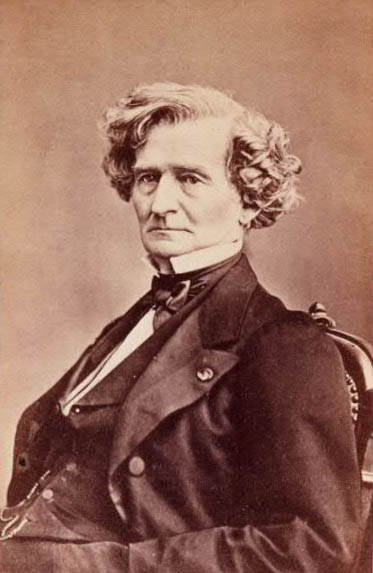
Hector Berlioz (1803-1869)
French composer Hector Berlioz (1803 - 1869) wrote a letter to a friend in 1830 stating:

'I am still unknown. But when I have written an immense instrumental composition which I am now meditating, I intend to go to London to have it performed. Let me win a brilliant success under her very eyes!'

The instrumental composition was to become his first symphony, called the Symphonie fantastique. I have studied the work for the last two weeks and focused intensely on the orchestration, which was by then unconventional and revolutionary. I want to give a breakdown of some of my findings, which will hopefully provide another perspective on how to appreciate Berlioz' arguably most popular work even more.


I - Rêveries - Passions

At rehearsal letter R1 (near the end of the movement) Berlioz gives the instruction: Tout l'orchestre aussi doux que possible, which means that the whole orchestra should play as soft as possible (the instruments are marked ppp). This can be heard at 14:20 in the video below

II - Un Bal

At bar 118, he instructs the violins to play presque rien - almost nothing (17:30)

III - Scène aux Champs

At the beginning of this movement Berlioz wants the first oboe derrière la scene to be played behind the stage, to further establish the distant answer call to the english horn. You can see the player has left his usual position in the video (22:30).

The other interesting device he used for this movement is his use of four timpani to mimic an oncoming thunderstorm. The players can be seen at 35:33.

IV - Marche au Supplice

At rehearsal mark M, Berlioz is very particular that the bass drum and cymbal should carefully observe their alternating dynamics of ff and mf (41:05).

V - Songe d'une Nuit du Sabbat

At the beginning of the final movement Berlioz sub-divides the violins and violas into 2 and 3 sections, and instructs them to play con sord. a punta d'arco - muted and only with the tip of the bow, to give a shimmer for the cellos and basses (42:48).

A nice little effect occurs at rehearsal letter A, when the piccolo, flute and oboe are instructed to perform a glissando on their instruments (43:20).

Next, Berlioz introduces orchestral bells, which are realised with steel plates in the video reference (45:50). He did remark that when the orchestra has no bells at its disposal, two pianos could be used as a substitute.

The bells are foretelling the DIES IRAE, which is a catholic chant often associated with death or suffering (46:14).

The last in a series of delightful orchestral effects occurs at rehearsal mark M1 with the strings playing frappez avec le bois de l'archet. I won't give the translation here as one must experience the effect without knowing what is happening, to fully appreciate its existence in this context (51:16)!


-PW

Thursday, 8 May 2014

Why film at a gig?

Krystian Zimerman (c) Kasskara and D/G
I have stumbled across this not-so-recent news article by the BBC in which pianist Krystian Zimerman went off stage during one of his concerts. The reason was that someone was filming with their smart-phone an didn't stop doing so even after the concert was interrupted. Therefore he walked off stage and although he finished the recital, he didn't play an encore and was seemingly annoyed. He commented afterwards:

'What happened is theft, pure and simple. It cuts particularly deeply when the artist is of a sensitive nature.'

No matter whether this is professional behaviour or not, the question I am asking myself is simply why bother? Why film at a gig?
There are no good arguments for doing so.

First of all it is disrespectful against the artist as you could not only make him uncomfortable and therefore diminish the performance for you and everyone around, but more importantly you are making the choice of rather looking at a screen and concentrating on filming than enjoying the performance. Roger Waters:

'It would seem to me to show a lack of respect to and care for fellow concert goers, or for that matter the artist.'

Everyone should remember, and those who have been in this position know, that even though you have 'paid' for the artist to perform, he or she is nevertheless performing for your entertainment, not because it is particularly fun to do so. The artist is putting himself in the spotlight for you to have a good time.

Secondly, the footage you create is probably of poor quality and will not be able to represent the event as it unfolded. Another BBC article quotes two girls when asked about their motivation to film at gigs: '[It's] memories, so you don't forget the good times,' however they also say: 'It is a bit annoying though sometimes when there is loads in front of your face and you can't see.' This is quite remarkable: they claim that they film to not forget the good times but say that they can't really see everything sometimes. Well that would imply they don't necessarily have a good time and should rather try to move to a better spot instead of wasting the experience. Which brings me to my final point, what experience?

Going to a concert for me not only meant to listen to the music first and foremost as I am able to do that with superior quality at home (exlcuding classical concerts). It was also about the performance, the experience of the pushing and shoving in the front row, or (as in the concert hall) to enjoy the anticipation of the music to come. This might all be lost while being occupied with filming, there is no experience when you go home apart from having held your smart-phone for an hour.

I am personally very concerned with the incentive of 'sharing' in our society. People seem to be easily motivated to share their lives for everyone to see. And one of the reasons they film at gigs might be that they almost 'need' something to 'share' or that there is an opportunity to share another part of their life. But instead they should rather live their lives, somehting a lot of people seem to forget more and more. I find that very sad as I am believing that the more someone shares the more this person loses its individuality, which might seem paradox at first but not so much after thinking about it.

-PW